
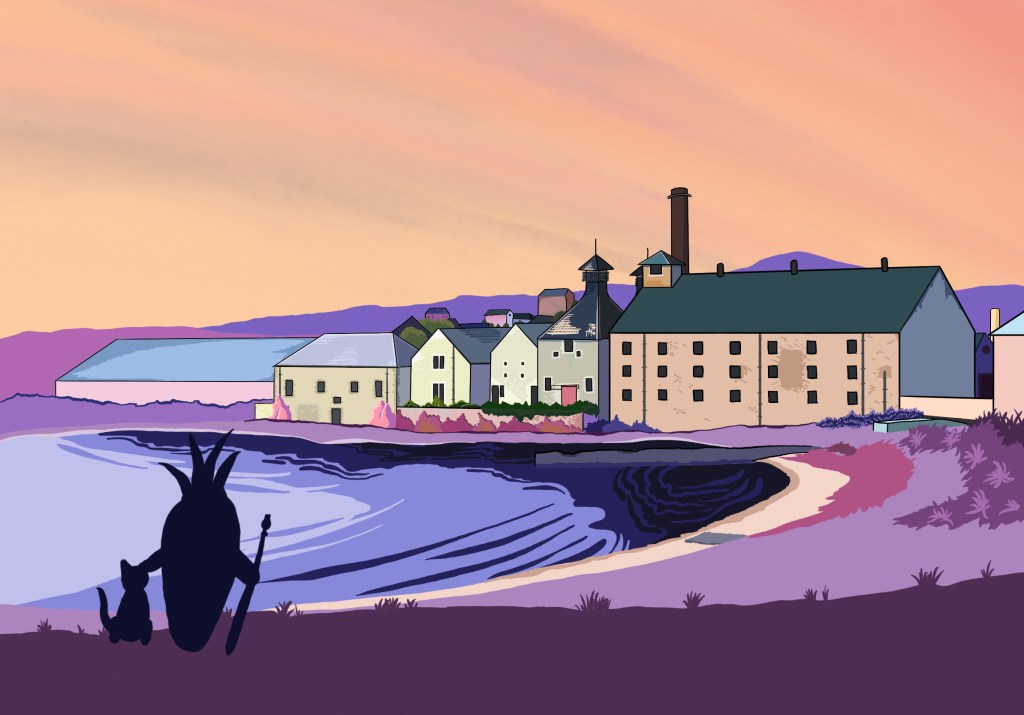
“At a distance the establishment looked like a cluster of ruins, but on nearer inspection we found it to be a Distillery of a very old-fashioned type…. The Whisky made at Laphroaig is of exceptional character, being largely sought after for blending purposes, and is a thick and pungent spirit of a peculiar ʻpeat reekʻ flavor.” – Alfred Barnard.
Barnard’s description of Laphroaig in The Whisky Distilleries of the United Kingdom, his travelogue of distillery visits in the 1880s, is relatively brief, but incredibly rich. While he sometimes spends time discussing production methods or the general lay of the distillery, he gave very little of that with Laphroaig. Instead he discussed the hospitality of the distillery crew, who insisted lunch be served before taking a brief tour, and the flavor profile of Islay:
“We cannot forbear a brief allusion to the fact that all the Distilleries in Islay are built on the sea coast, but the Distillers maintain that the sea air has no effect whatever on the Whisky, and that the peculiarity of the Islay make arises principally from the flavor of the peat, dug in the island, and which is more strongly impregnated with moss than some other districts.”
I love that the discussion of maritime flavor profiles, especially as they relate to Islay, have been going on for well over a century and a half. The question of why Islay, or other maritime malts, get that flavor profile comes up all the time, especially for those who first encounter it and wonder why in the world the whisky feels salty!
As Barnard hints, the simple and logical explanation must be the proximity of the distilleries to the sea. That makes sense at first blush, but of course a closer examination leaves that explanation wanting. After all, few casks are still matured on Islay, most are shipped to the mainland for maturation in bonded warehouses there, or take off Islay by tanker and filled into casks on the mainland. As a result, the environment in which the casks are resting would be an unlikely source for the maritime flavors. Sea spray contamination of whisky production would also be unlikely as those environments are fairly controlled in order to prevent unwanted contamination of all sorts, much less the threat of corrosion by salt air.
Rather the peat is where we might look; much as Barnard explains that the distillers told him. Many of the distilleries on Islay use peat from the island. Yet, not all do! Bruichladdich famously sources its peat from the mainland for its peated products, Port Charlotte and Octomore, after finding their local peat bogs did not produce a desirable flavor profile. Not all peat is created equal, and highland peat tends to be ashier, earthier, and more campfire-like than the medicinal, vegetal, brine of Islay. Compare Port Charlotte or Ardmore to Lagavulin or Laphroaig and you may see what I mean.
The Laphroaig that Barnard visited was considerably smaller than the distillery today. He gives the total production as 23,000 gallons per year, or about 104,000 liters per annum, whereas its 2026 capacity is 3.3 million liters. According to Barnard, for the last sixty years (as of the 1880s), the entire production of Laphroaig went to Messrs. Mackie & Co. of Glasgow. They were one of the biggest whisky firms at the end of the 1800s and dawn of the 1900s, owning Craigellachie and Hazelburn. Laphroaig eventually split from Mackie & Co., which precipitated a heated feud between the distillery and Peter Mackie, with Mackie eventually blocking Laphroaig’s water supply and building Malt Mill Distillery within Lagavulin to replicate the Laphroaig style for its blends.
Today the distillery is one of Suntory Global’s two Islay outposts, the other being Bowmore. Those distilleries are well-known as single malts, and Laphroaig has a long history of being bottled and sold as a “single whisky.” Laphroaig has a wide core range, from the Select at one end of the price spectrum, to the 25 Year and various special releases at even greater age statements.
The distillery has also long been a mainstay among independent bottlers, though there was a dramatic dip in cask availability during the heady days of the 2010s and early 2020s when demand for whisky grew dramatically. Since that period, casks have again returned to the market and prices have begun to come down, at least for younger malts. The long term effects of that period in which the distillery sold few casks may mean that older drams remain elusive and expensive. Certainly the whisky is easier to find, from a variety of sources, than it was during Barnard’s days.
So here we go, a few weeks dedicated to all things Laphroaig!
Artwork this week is my own: with the academic year completed, I finally had some time to draw. The drawing is based on a late 19th century photograph of the distillery, which is missing a few of its modern flourishes and structures.



Leave a Reply