
“When free from its soft covering of clouds there is a grand view from the summit of Ben Nevis, and the spectator is astounded at the wild and strange sublimity of the scene, augmented by the depth of the surrounding precipices. Gazing over the horizon an ever-changing panorama meets the eye; now Ben Cruachin, Ben Lomond and other lofty mountains in the far distance are revealed, then for a time they will be hidden by banks of mist that sailing on the wind filled the rugged depths of chasms, black as night, and impenetrable to the eye and light of day. These again pass away and the awe-struck spectator finds himself amidst cloud and mountain scenery, the beauty and ever-changing complexion of which no words or pen can describe.” – Alfred Barnard.
While Barnard gave many distilleries a page or two of description, he awarded the countryside and landscape around Ben Nevis a little over two pages before he even gets to the distillery. His published travelogue of distillery visits in the 1880s, The Whisky Distilleries of the United Kingdom, gave four full pages over to the landscape and distillery of Ben nevios. He followed this with six more pages and two illustrated plates of the new “Nevis” distillery that was built next door in 1878. Those two facilities, one the traditional and the other a strikingly modern operation, were formally merged in 1908.
It is impossible to miss the impact the two visits had on Barnard. He dedicated more pages to them than most distilleries he visited. When his first visit was cut short due to necessary travel, he made a point to return six months later and complete his tour.
Barnard could be a romantic at times; not in his descriptions of love between humans, but as someone influenced by the romantic movement. Though he wrote about industry and production methods, he frequently paused to glorify in the landscape and nature he travelled through. Invoking the sublime near the outset of the quoted material above, and ending with a statement that the view was indescribable, he confronts the quasi-religious experience and revelation the romantics sought in nature.
He focused just as much on the experience of a place, or the passage through the landscape, as he did the actual production of whisky. His work could be read as an argument for the importance of place in whisky production, something marketers and distillery tours would surely like to impress upon the public, even as large operations typically tanker off their production to be casked and matured elsewhere.
“Its near presence and supreme dignity, standing out, as it does, from the surrounding hills, awed us, and suggested the might and power of the Great Creator. As we looked on its heights and glimmering peaks, dark projections of rock peered out and broke up the spacious white mantle, whilst at the top, the frozen snow glittered in the sunbeams, and contrasted brilliantly with the black masses beneath. We continued our journey and neared our destination keeping this glorious prospect in view, our minds full of the wonders we had witnessed, and thankful that we had been permitted to gaze upon this stupendous work of creation, clothed in all its winter glory.”
Reaching the distillery in the summer, Barnard provides a bucolic impression of the industrial site situated in the greenery of nature: “As we drove in at the gates of the Distillery we were struck with the picturesque appearance of the buildings, all of which are grouped about on a carpet of green, bordered with fir plantations, in striking contrast to the background of the mountain whose projections intrude themselves up to the walls of the Distillery.”
Yet, Barnard did not focus solely on the environment, he celebrated modern production methods and industry, something that stands in starker relief during his visit to the Nevis distillery the following winter: “There was a foreign air about the whole proceedings; the dazzling whiteness of the concreted buildings, the numerous carts, gaily painted a crimson and green color, laden with casks of Whisky, the big coopers with their leathern aprons, the noise of the blacksmith’s anvils, the Distillery clerks and excitement running to and fro, reminded us of the champagne districts.”
During this second stay, Barnard spent far more words describing the very modern works of the newer Nevis Distillery and the production flow therein. It was a model of what is to come, he reckoned, and described it as neat and orderly, “everything goes on like clockwork, and the workmen seem to take a pride in keeping all the vessels sweet, bright, and clean.”
Amid the hustle and hum of production in the newer Nevis Distillery Barnard carried us away from the wildness of nature, and into the center of human industry. The contrasts are multiple and play into the foreignness Barnard felt as he observed the distillery workers, some 200 of them by his count, prepare a large order to export from the distillery warehouses. Here, everything was modern, running with an efficiency that he found commendable and strikingly progressive compared to the much older distillery site next door.
The great thing about these descriptions is how much they encapsulate the tension between tradition and modernity or nature and industry. The contemporary scotch industry plays with these tensions constantly, celebrating new advances in efficiency of production, bio-dynamism, energy use, peat burning, or maturation, while simultaneously celebrating how little has changed in the last several hundred years. Marketing loves to pinpoint the stunning countryside and clarity of the waters used for whisky production, while sidestepping the industrial scale at which this occurs and the tendency of much whisky to not be matured at the site of production, or to use the same barley and same yeast as others. Long industrial warehouses in the Lowlands and giant grain production plants are not nearly as romantic as a dunnage warehouse or brick still house in the Highlands.
Barnard highlights similar tensions between tradition and modernization, though he celebrated both as worthy endeavors. The question of nature, and perhaps terroir, is more difficult to resolve; few want to see every spare meter of the Highlands carpeted in the large maturation warehouses to keep everything local. Yet, there is something romantic about the place, and imagining that we can taste the place– that Ben Nevis whisky has some element of the towering peaks from which it gets its name.
Barnard was on to something.
So here we go, a few weeks dedicated to all things Ben Nevis!
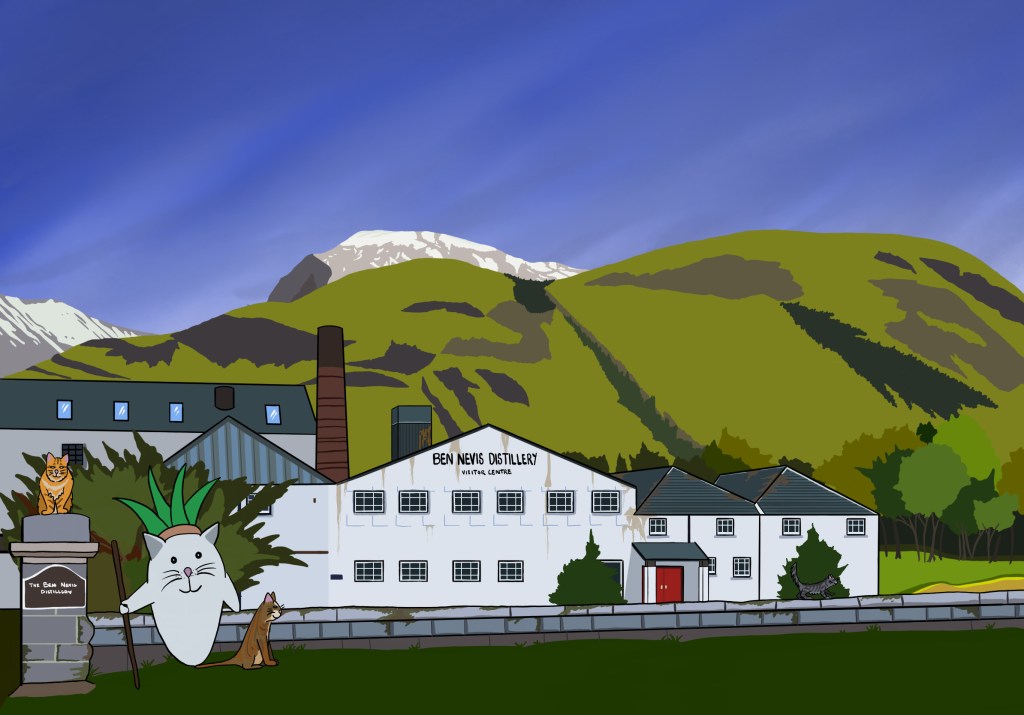
Artwork this week is my own: with the academic year completed, I finally had some time to draw.





Leave a Reply