
“On leaving Keith, the railroad pursues its course through a beautiful hilly country, clothed with rich and variegated foliage, passing over several mountain streams, whose waters run in furious haste to join the larger river… When we arrived at Dufftown Station, we were informed that the village and the Distillery were some considerable distance away, so we hired the only vehicle, an antiquated machine, deficient in springs and requiring renewals in several places.” – Alfred Barnard.
I love to start with a quote from the whisky writer and traveller Alfred Barnard, whose tour through the United Kingdomʻs industry in the 1880s captured a fascinating moment in time. While he often focused on technical details, occasionally he shifts to giving a slice of life or vivid, albeit economical, description of the countryside through which he passed.
The great tome of his collected writings, The Whisky Distilleries of the United Kingdom, has no overarching narrative and reads about as well as an encyclopedia or dictionary if one starts from one cover and tries to go to the next. I enjoy it best when I flip to the relevant entry while pouring a dram. Each entry is only a page or two long, so one can flip back and forward from an entry to read about nearby distilleries, especially the multitude of lost distilleries.
The entry for Mortlach is sparse and focused almost entirely on the journey to get there, illustrating in plaint terms the remoteness Barnard felt during his brief sojourn. If the length of the entry is any indication of its importance, then Barnard may not have thought much of the distillery as he dedicated significantly more words and pages and words to Miltonduff from which he traveled to Mortlach, and Inchgower, where he journeyed next.
By the time Barnard visited in the 1880s, distillation had been taking place at Mortlach for more than half a century. The distillery opened in 1823, and by 1900 had changed hands five times. On its hundred anniversary, the John Walker subsidiary of Distillers Company Limited purchased the distillery and it has been part of DCL (now Diageo) ever since.
The distillery is notable today for the use of worm tubs for cooling the spirit vapors, which contributes to the hefty and meaty style of the malt. Few distilleries in Scotland still use worm tubs, preferring to avoid the extra maintenance they require. It also has a slightly odd production regime with a partial triple distillation similar to Springbank and formerly Benrinnes. 20% of the low wines from the no. 1 and no. 2 wash stills are diverted into the no. 1 spirit still, also known as the Wee Witchie, where they are distilled three times before a middle cut is taken and later mixed with the rest of the production.
It is also notable as one of the few single malt brands that Diageo has pushed in the 2010s, taking the distillery from relative obscurity as a central component for Johnnie Walker Black, and presenting it as a high end single malt. It may be debatable as to whether that has been a success, though certainly sales improved dramatically over the years, but the oddest part is perhaps that while Diageo invested heavily in the creation of Mortlach as a brand, the distillery has no visitor’s center. Not every distillery needs a place for the hoi polloi like me to drop in, but for a distillery with visibility and branding as a single malt, it’s a bit strange.
So here we go, a few weeks dedicated to all things Mortlach!
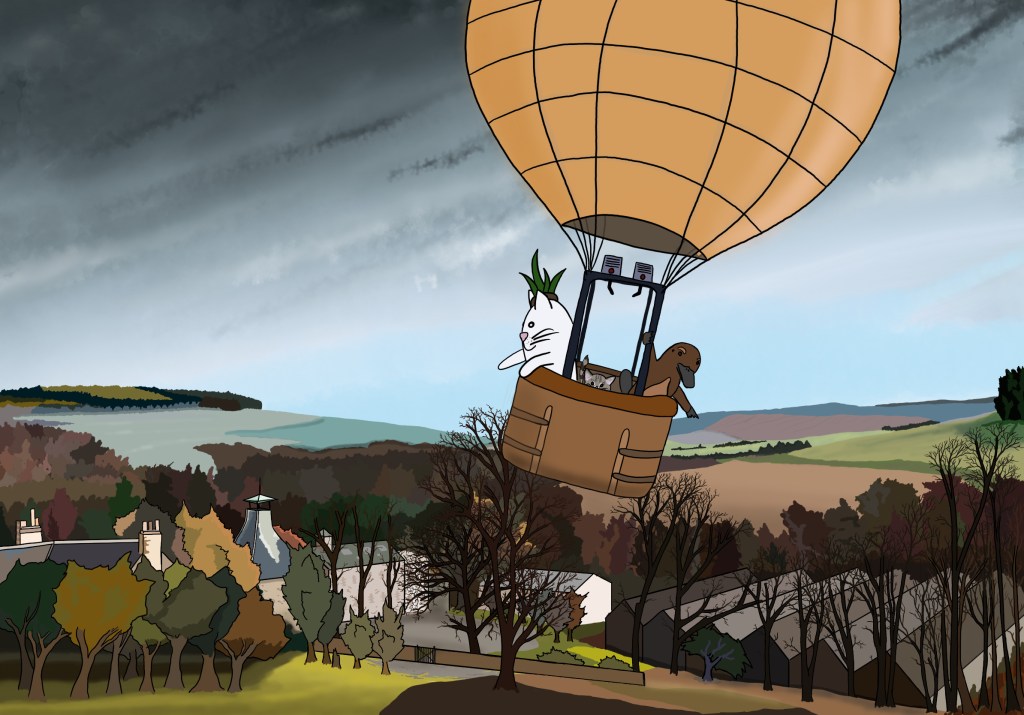
Artwork this week is my own: it took me several months to actually get around to finishing this drawing as the busy work of the semester kept distracting me.

 Whiskery Turnip
Leave a comment