
My love affair with Glenburgie began with a feisty 7-Year old whisky from SMWS, aptly titled Farmyard Feedback Loop. I enjoyed it so much that I followed it up with a very similar 7-Year, Rubbed with Fragrant Body Oils, as soon as I could. It was after that pair that I discovered the wonderfully tropical Glenburgie produced in the summer of 1995 and, from there, there was no turning back.
What sets Glenburgie apart for me is the wonderful combination of earth, florals, and fruits– elements that shine best in an ex-bourbon or refill cask. Good friends seek out similar profiles from Linkwood, Tormore, Longmorn, Ben Nevis, and Glen Keith, so Glenburgie is not entirely unique. However, I find the right balance of those elements, the magic ratio that takes me back to botanical garden afternoons and evenings, appears most often in Glenburgie.
For those unfamiliar with the distillery, it is one of the larger Speyside operations under Chivas Brothers, and has for a long time been a central component of the Ballantine’s blended whiskies. The distillery came under the Hiram Walker umbrella in 1936, and restarted operations nearly a decade after being mothballed. While malts produced in some of the earlier incarnations of the distillery may well exist in old bottles of blends, the earliest single malts for which there are whiskybase date from last two years of the 1940s. I have not been so fortunate as to try any of those malts, but I did have the opportunity to try a 30-Year distilled in 1954 which was far dirtier than anything produced by the distillery since at least the early 1980s.
In 1958 a pair of Lomond stills were installed at Glenburgie, allowing the distillery to produce a lighter style for blenders to use in their alchemy (and save the company from building another distillery to do so; these experiments took place at a number of Chivas properties). If you see an old bottle labeled “Glencraig,” that was the malt produced on Glenburgie’s lomond stills until they were removed in 1981.
The distillery was torn down and rebuilt in 2004, only the four old stills, the boiler, and mill were retained, so some consider the whiskies produced after 2004 to be a completely different animal than those before. I have not found the difference quite as remarkable as say the reconstruction of Caol Ila in 1972, but I do find that the post-2004 malts generally heavier, though still no more suited to robust sherry maturations than the older ones. We will see what time does to the malt, but you know I will be keeping a close eye on it.
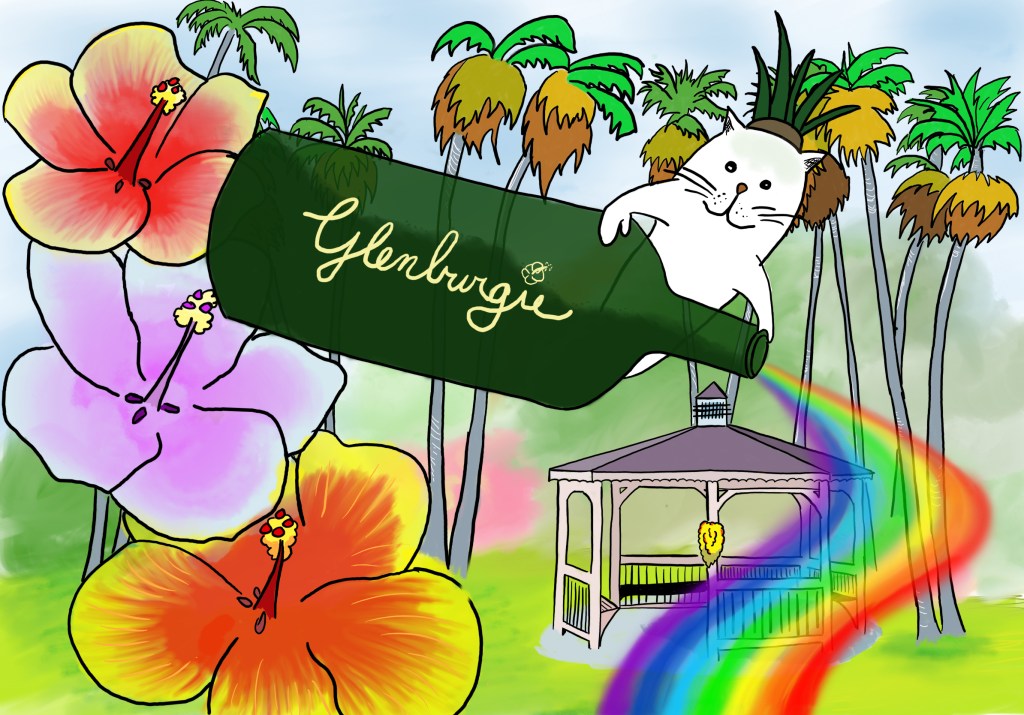
Artwork this week is my own; the floating, or flying, whiskery turnip is pouring a giant bottle of Glenburgie at the Foster Botanical Garden gazebo; so many Glenburgie take me back to that place with their tropical aroma and profile.

 Whiskery Turnip
Leave a comment